
915 MHz Antenna Comparison
VNA-measured comparison of 915 MHz LoRa antennas.
915 MHz LoRa Antenna Comparison for Meshtastic (Measured with VNA)
Real-World 915 MHz LoRa Antenna Comparison for Meshtastic Nodes
Site: NWIMesh.net Author: Matt – W9MDM Test Equipment: Siglent Vector Network Analyzer (VNA) Sweep Range: ~792 MHz – 1.02 GHz Center / Marker Reference: ~906.875 MHz (used for “apples-to-apples” comparison) Measurement: S11 (SWR + S11/Smith)
Affiliate Disclosure: As an Amazon Associate, NWIMesh.net earns from qualifying purchases. Some links in this post are affiliate links, which means we may earn a small commission if you purchase through them, at no additional cost to you.
Community Data Notice: Additional antenna data in this article is sourced from the Meshtastic Community Antenna Reports repository, published under the GNU General Public License v3 (GPLv3). Those results represent community-contributed VNA testing. All logos, brands, and product names remain copyright their respective owners.
TL;DR
At the ~906.875MHz reference point used for this comparison, the Seeed SenseCAP stock antenna shows the lowest SWR and best single-frequency match. However, the ALFA AOA-915-5ACM is the better real-world performer for most Meshtastic installations due to its more consistent impedance behavior across the US-915 band, higher effective efficiency, and superior build quality — a conclusion independently supported by the Meshtastic community antenna report for this model.
The Clarifi 8dBi antenna is electrically clean and PA-safe but is a specialized tool intended for long, flat, horizon-level paths where its compressed vertical beamwidth is an advantage. The knock-off antenna can appear acceptable on SWR at certain points but relies on reactive behavior and internal loss, making it suitable only for low-power edge nodes. The LilyGo/T-Beam stock antenna performs poorly near 906MHz and should be replaced for any serious deployment — a finding that matches the community repo’s verdict on the Stock T-Beam antenna (also rated ❌ No).
Antennas Tested (NWIMesh VNA Lab)
- ALFA Network AOA-915-5ACM – ~5 dBi Omni
- Clarifi 915 MHz – ~8 dBi High-Gain Omni
- Seeed SenseCAP Solar Pro P1 stock antenna – “868–915” included antenna
- LilyGo / T-Beam stock 915 antenna – included antenna
- Slinkdsco / Knock-Off 915 MHz Omni – third-party “Meshtastic” antenna
Important note: SWR and Smith charts indicate how the antenna loads the radio (impedance / mismatch). They do not directly measure gain or radiation pattern. High-gain antennas can still show “okay” SWR while being the wrong tool for a specific deployment geometry.
Quick Scorecard at ~906.875 MHz
This table is taken directly from the marker readouts shown in the screenshots below.
| Antenna | SWR @ 906.875 MHz | Return Loss (S11) @ 906.875 MHz | Community Repo Verdict | Notes |
|---|---|---|---|---|
| Seeed SenseCAP P1 stock (868–915) | ~1.14 | ~-21.84 dB | ⚠️ Note below | Best match at the 906.875 MHz reference point. Note: a different Seeed 915 antenna (model 318020612) in the community repo was flagged as hardware-damaging — this is NOT that antenna. |
| Knock-Off Omni | ~1.23 | ~-18.60 dB | — | Looks good electrically here; keep it on low-power / edge roles |
| ALFA AOA-915-5ACM | ~1.34 | ~-15.98 dB | ✔️ Yes | Good, stable behavior; strong general-purpose choice. Also community-approved in the Meshtastic antenna reports. |
| Clarifi 8 dBi | ~1.65 | ~-12.66 dB | — | Usable but not centered here; pattern matters more than SWR at 8 dBi |
| LilyGo / T-Beam stock | ~3.61 | ~-4.84 dB | ❌ No | Poor match at 906; replace for anything beyond portable testing. Community repo independently rates the Stock T-Beam ❌ No. |
SWR Screenshots (Tr1 S11 SWR)
These are the SWR sweeps. The marker value at ~906.875 MHz is the number used in the scorecard above.
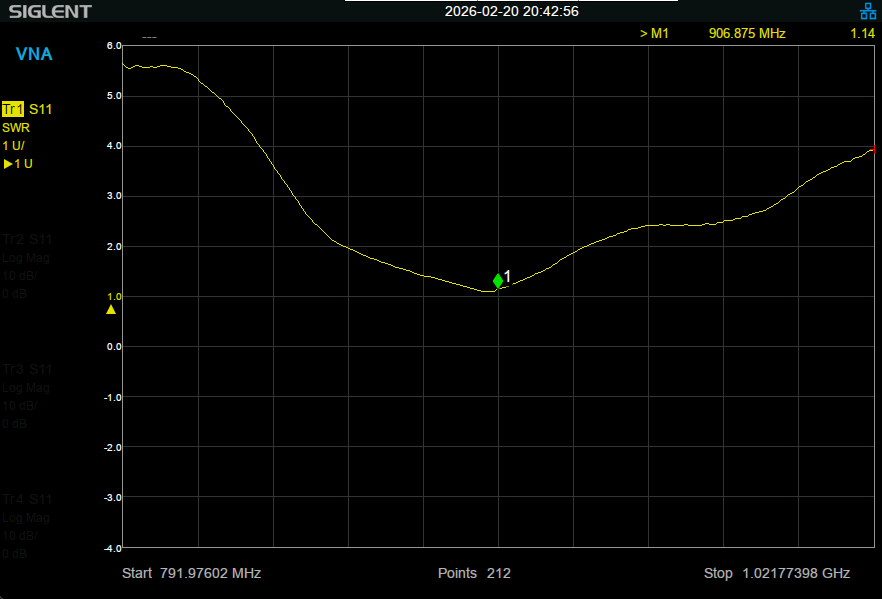 SWR at marker ~906.875 MHz is ~1.14.
Knock-Off Omni – SWR
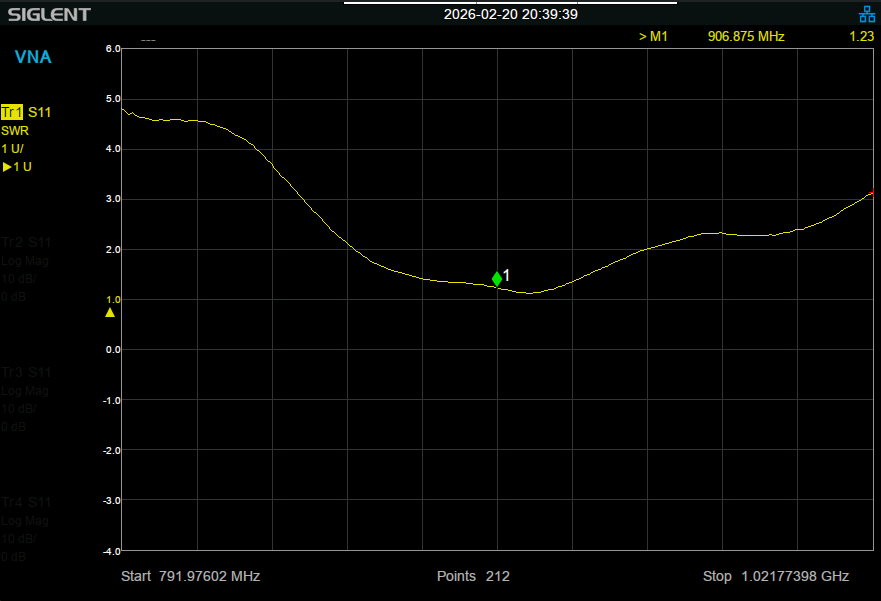 SWR at marker ~906.875 MHz is ~1.23.
ALFA AOA-915-5ACM – SWR
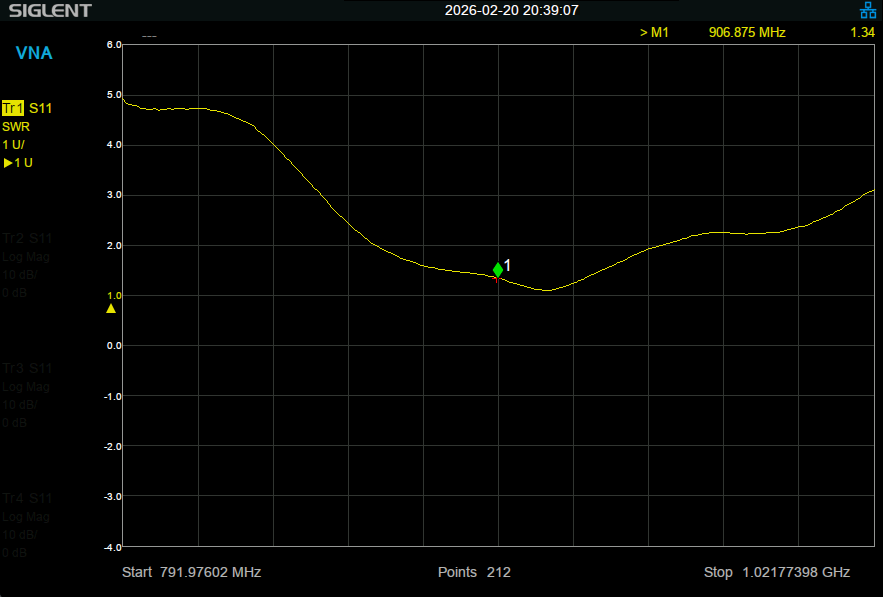 SWR at marker ~906.875 MHz is ~1.34.
Clarifi 8 dBi – SWR
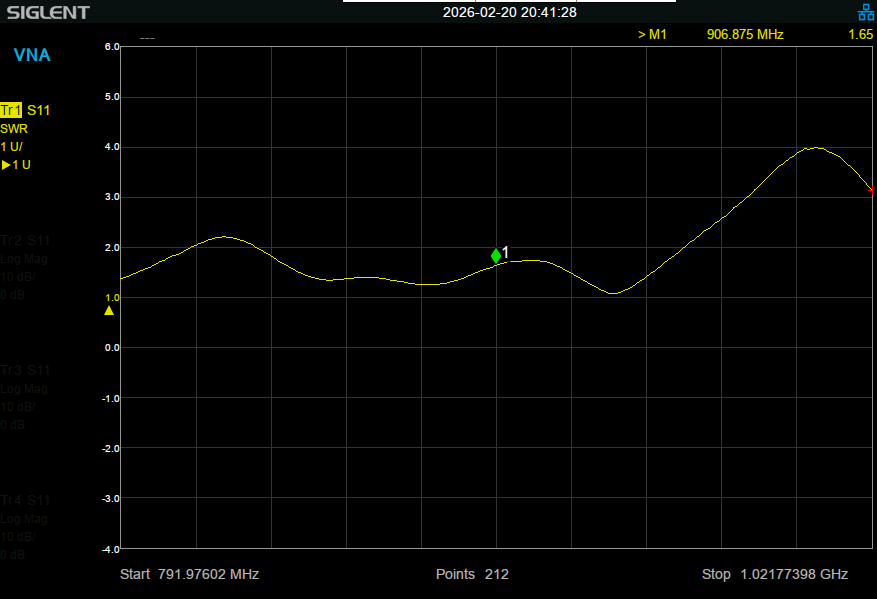 SWR at marker ~906.875 MHz is ~1.65.
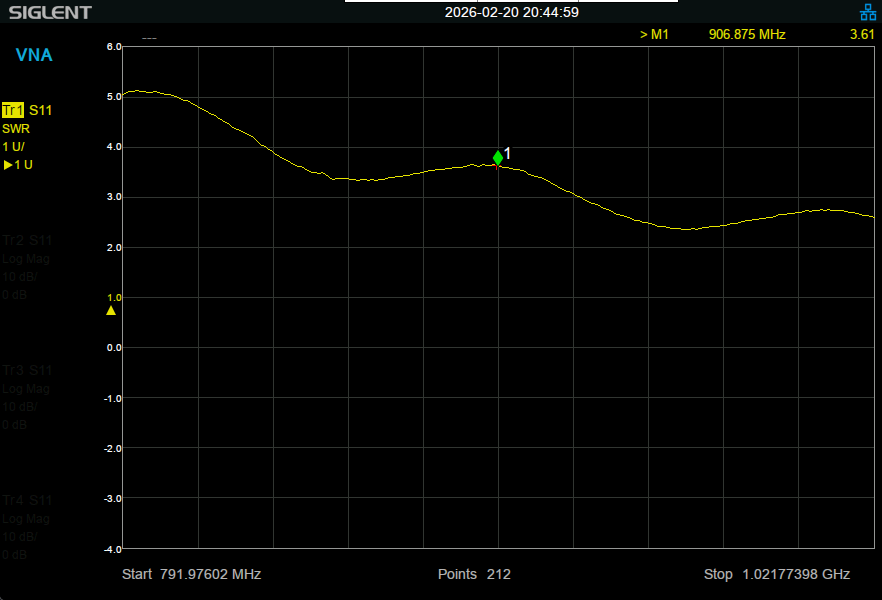 SWR at marker ~906.875 MHz is ~3.61 (poor).
S11 “Smith Chart” Screenshots (Tr1 S11 Smith/Log)
These plots show the complex impedance behavior across the sweep. The value shown at top right is the marker return loss (dB) and angle at ~906.875 MHz. This helps explain why two antennas with “similar SWR” can behave very differently with real radios and PAs.
Seeed SenseCAP Solar Pro P1 Stock Antenna (868–915) – S11 / Smith
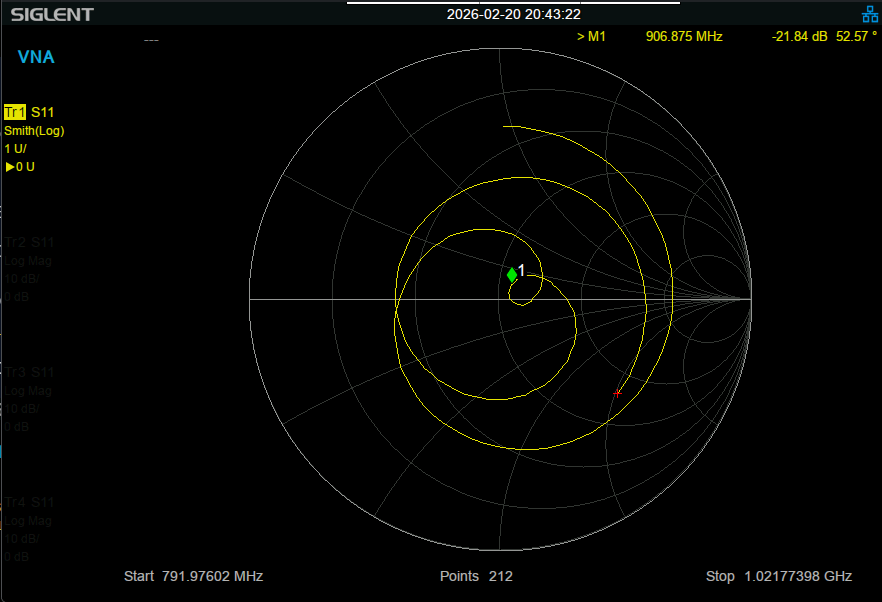 Return loss at marker ~906.875 MHz is ~-21.84 dB (excellent).
Knock-Off Omni – S11 / Smith
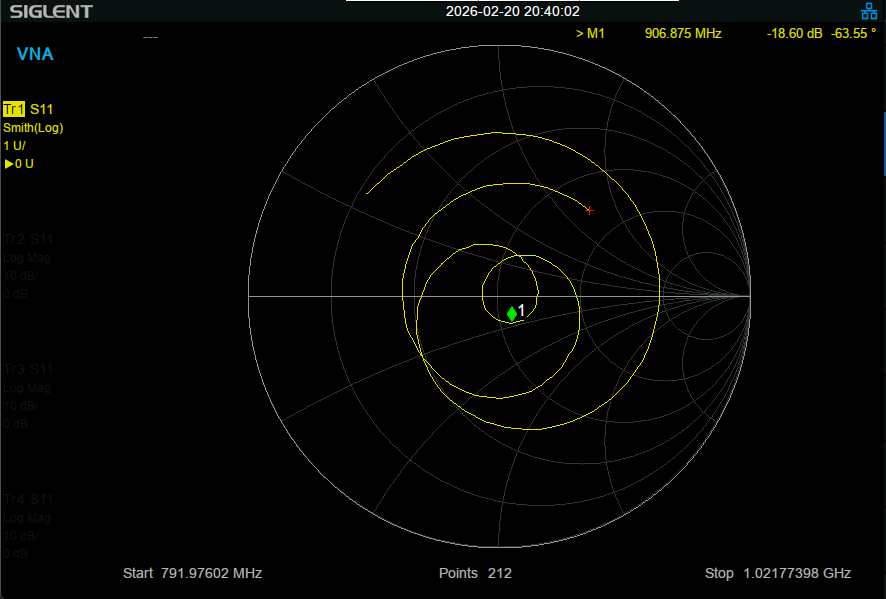 Return loss at marker ~906.875 MHz is ~-18.60 dB.
ALFA AOA-915-5ACM – S11 / Smith
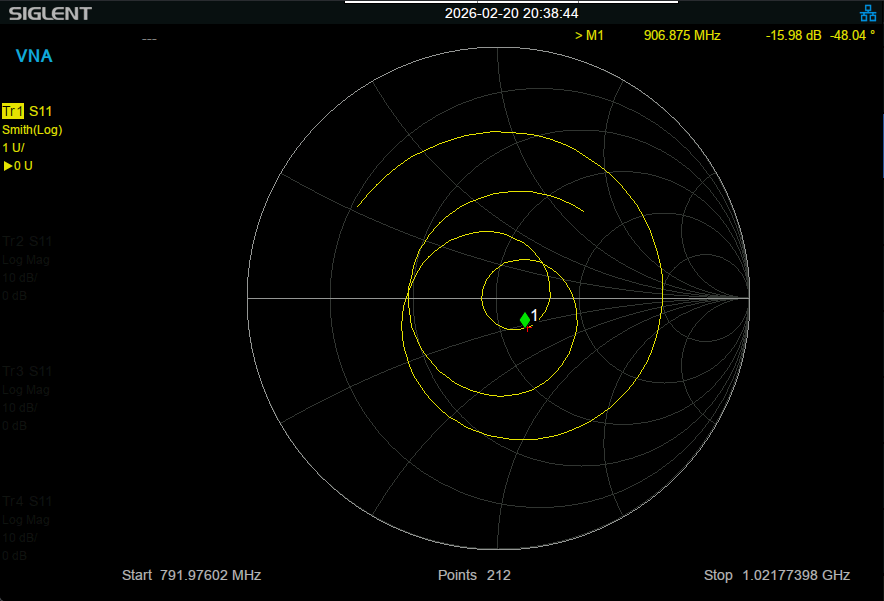 Return loss at marker ~906.875 MHz is ~-15.98 dB.
Clarifi 8 dBi – S11 / Smith
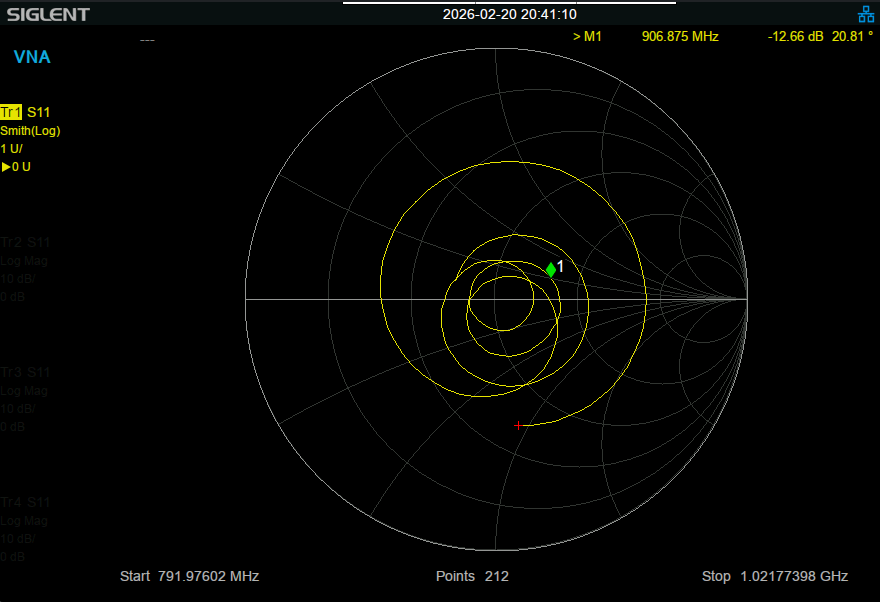 Return loss at marker ~906.875 MHz is ~-12.66 dB.
What This Means in Practice (Important)
The Clarifi 8 dBi is not an “upgrade everywhere” antenna.
- Compresses vertical beamwidth
- Pushes RF energy toward the horizon
- Can reduce performance for nearby or lower-elevation nodes
Because of this, placement and terrain matter more than SWR when deploying high-gain omnis.
LilyGo / T-Beam Stock 915 Antenna – S11 / Smith
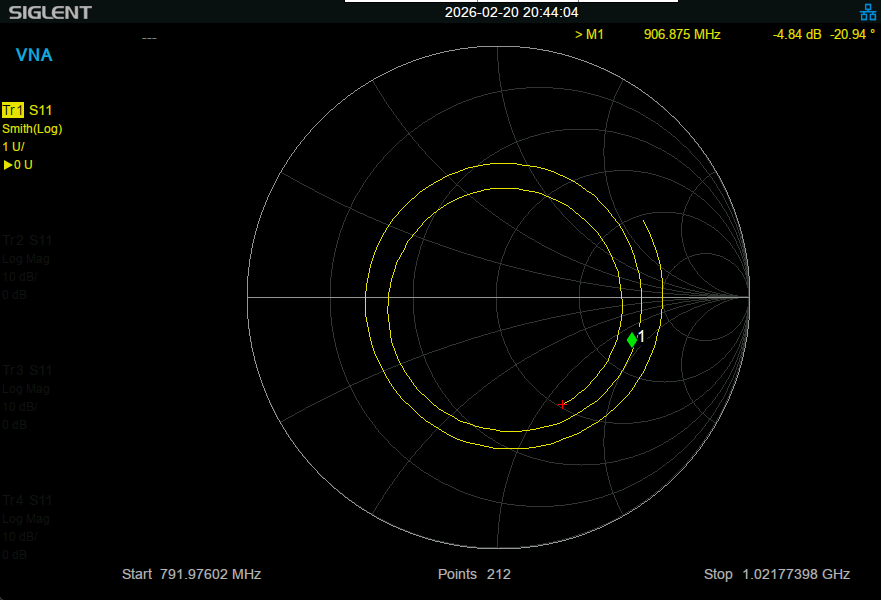 Return loss at marker ~906.875 MHz is ~-4.84 dB (very poor).
Round 2: Station G3, Slinkdsco Fiberglass, and Rokland 12 dBi Yagi (NWIMesh VNA)
A second bench run on the NWIMesh VNA, same Siglent sweep and the same ~906.875 MHz marker reference used above. Two of these surprised us: a cheap Slinkdsco waterproof fiberglass posted the best in-band match of anything we have swept, and the Rokland 12 dBi Yagi is flat and clean across the entire band.
| Antenna | SWR @ 906.875 MHz | Return Loss (S11) @ 906.875 MHz | Verdict | Notes |
|---|---|---|---|---|
| Slinkdsco waterproof fiberglass | ~1.06 | ~-30.7 dB | ✔️ Yes | Best in-band match we have measured. Resonance sits right on US-915. Genuinely good for the price. |
| Rokland 12 dBi AYA-9012 Yagi | ~1.41 | ~-15.4 dB | ✔️ Yes | Directional. Flat, low SWR across the whole sweep. The tool for a point-to-point backbone link or a one-direction coverage gap, not a general node antenna. N-female. |
| B&Q Station G3 stock antenna | ~1.79 | ~-11.0 dB | ✔️ Yes (tuned high) | The antenna in the box with the Station G3. Usable in-band, but its minimum sits up near ~960 MHz, so it is tuned a little high for US-915. Fine as shipped; a centered omni would edge it out. |
SWR sweeps (Tr1 S11 SWR)
Slinkdsco waterproof fiberglass — SWR
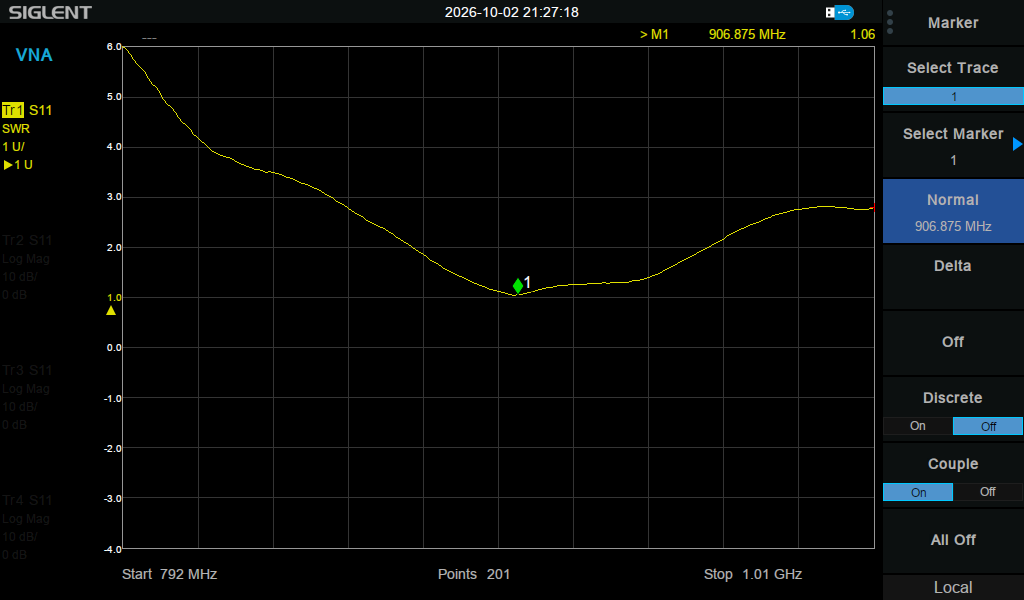 SWR at marker ~906.875 MHz is ~1.06, with resonance centered on the band.
Rokland 12 dBi AYA-9012 Yagi — SWR
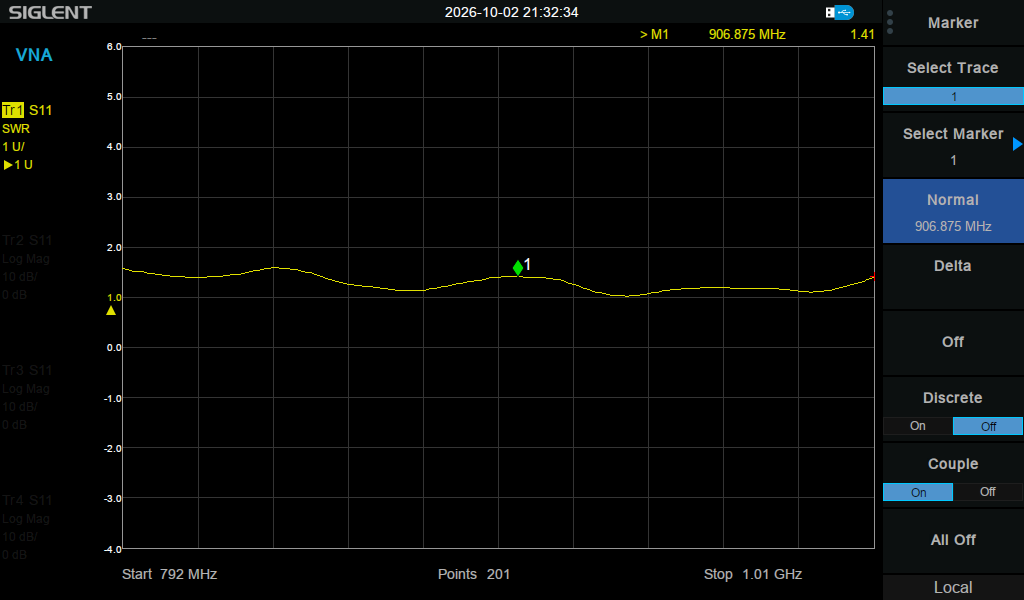 SWR at marker ~906.875 MHz is ~1.41, flat (~1.2 to 1.6) across the entire sweep.
B&Q Station G3 stock antenna — SWR
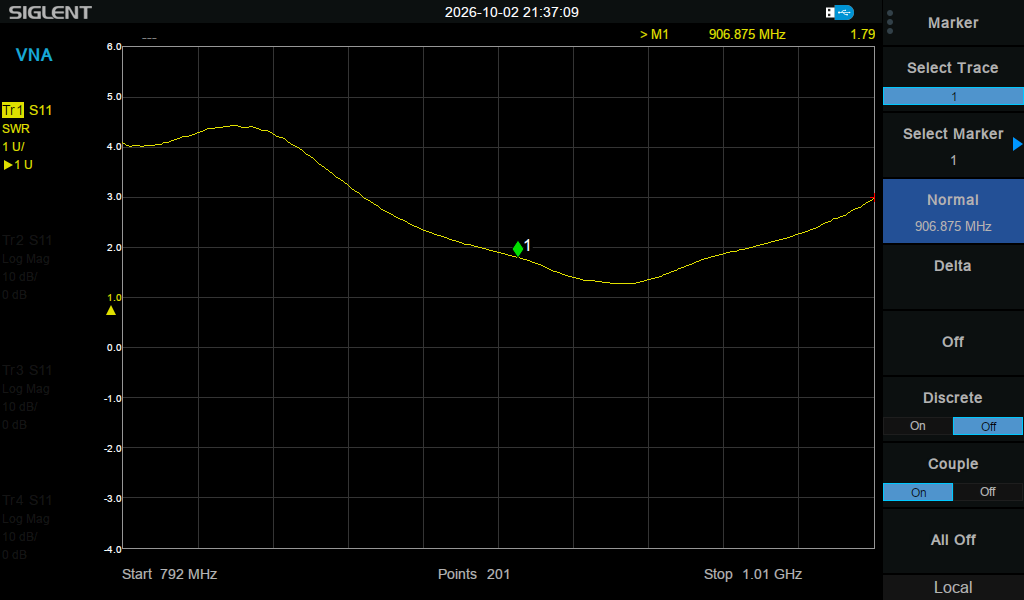 SWR at marker ~906.875 MHz is ~1.79; the minimum (~1.3) sits high near ~960 MHz.
Smith charts (S11)
Slinkdsco waterproof fiberglass — Smith
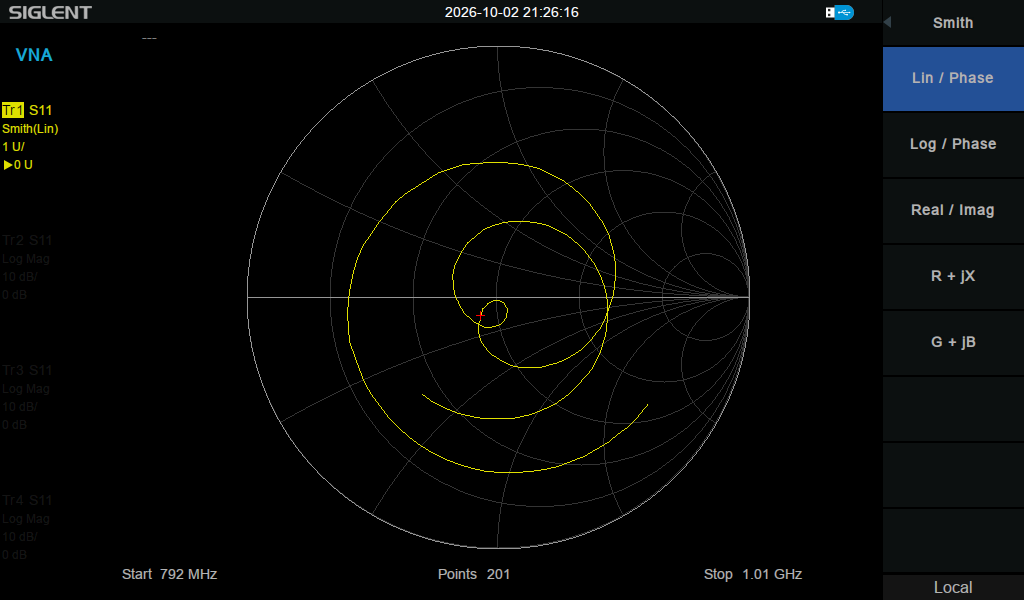 Return loss at marker ~906.875 MHz is ~-30.7 dB; the marker sits right at the 50-ohm center.
Rokland 12 dBi AYA-9012 Yagi — Smith
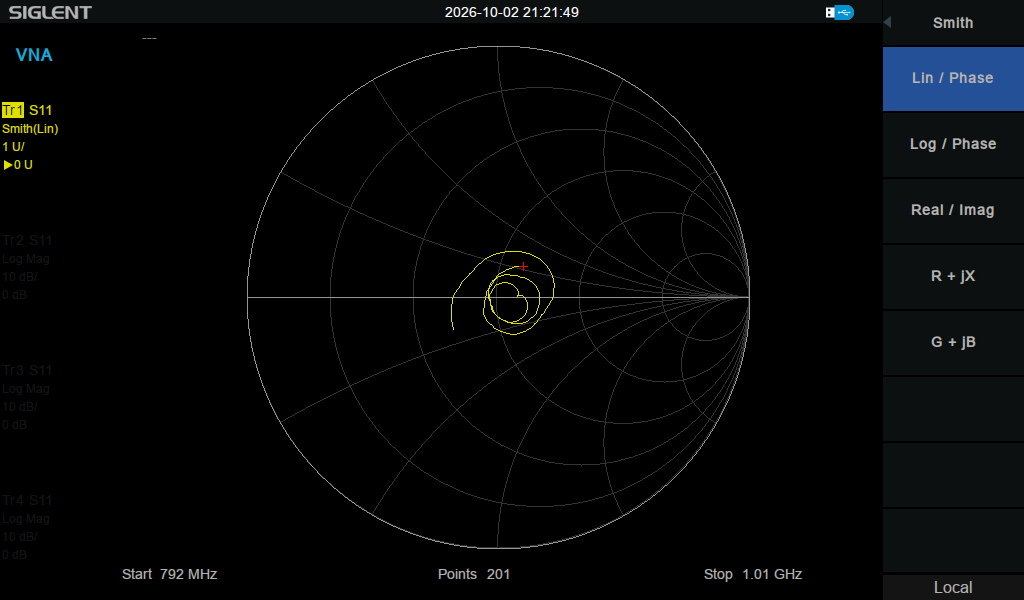 Return loss at marker ~906.875 MHz is ~-15.4 dB.
B&Q Station G3 stock antenna — Smith
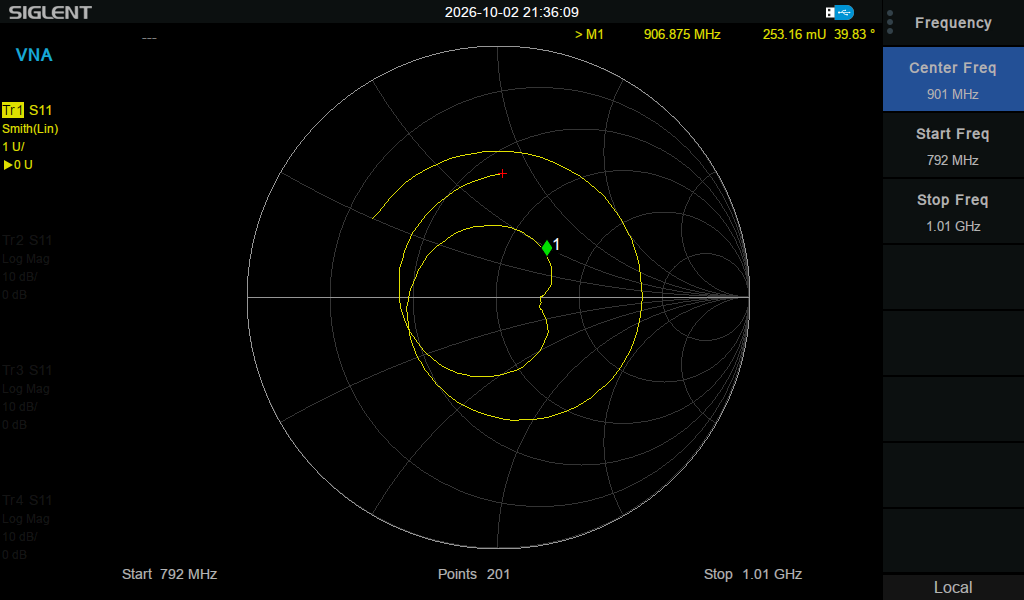 Return loss at marker ~906.875 MHz is ~-11.0 dB.
Community-Verified Antennas: Additional 915 MHz Options
The following antennas have been tested and approved by the Meshtastic community via the official antenna-reports repository (GPLv3). These have not been independently sweep-tested on the NWIMesh VNA bench but carry a community ✔️ rating and are worth considering depending on your node role. Gain figures are manufacturer-stated.
Fixed / Base Station Antennas
| Brand / Model | Gain | Pattern | Size | Community Verdict | Notes |
|---|---|---|---|---|---|
| ALFA AOA-915-5ACM | 5 dBi | Omni | 177mm × 21.5mm | ✔️ Yes | Also tested on the NWIMesh VNA. Best all-around infrastructure antenna. Compact form factor, excellent band behavior. |
| Rokland 5.8 dBi Large Profile | 5.8 dBi | Omni | 800mm × 25mm | ✔️ Yes | 35° vertical beamwidth. Solid outdoor build rated to 60 m/s wind. Good step up from the ALFA for elevated infrastructure nodes with line-of-sight. N-male connector. |
| Rokland 6 dBi Low Profile | 6 dBi | Omni | 650mm × 25mm | ✔️ Yes | 35° vertical beamwidth. Shorter and lower-profile than the 5.8 large-body version while squeezing out a bit more gain. Good for rooftop nodes in mixed terrain. N-female connector. |
| RAK Wireless 3 dBi Fiberglass | 3 dBi | Omni | 360mm × 35mm | ✔️ Yes | IP67-rated, designed for outdoor sub-GHz deployment. Wider vertical beamwidth than high-gain options — good choice for urban installs where nearby node coverage matters as much as long range. N-male connector. |
| ZDTECH ZD-OA-915-7NM | 7 dBi | Omni | 360mm × 23mm | ✔️ Yes | Community-approved mid-gain option. Compact for its rated gain. Good option if you need more reach than the ALFA without going full high-gain. Comes with 20ft cable. |
Directional / Panel Antennas
Directional antennas are the right tool when you need to bridge a specific long-haul path — a point-to-point backbone link, a remote node across a valley, or a coverage gap in one specific direction. They are not general-purpose infrastructure antennas.
| Brand / Model | Gain | Pattern | Community Verdict | Notes |
|---|---|---|---|---|
| ARC Wireless ARC-PA0913C01 (Community PDF) | 13.2 dBi | Panel | ✔️ Yes | 13.2 dBi panel antenna — very high gain with a narrow beam. Excellent for long-haul directional backbone links. 389mm × 389mm panel form factor. Not suitable as a general-purpose node antenna. |
Portable / Handheld Antennas
The community repo includes a number of tested portable/whip antennas for handheld and mobile nodes. These have all received a community ✔️ rating and represent upgrades over unchecked generic alternatives.
| Brand / Model | Size | Community Verdict | Notes |
|---|---|---|---|
| Linx ANT-916-CW-HW-SMA (Community PDF) | 120mm × 9.25mm | ✔️ Yes | ~$9.89 (current Amazon price may vary). Good SMA whip for portable/handheld nodes. Well-characterized by the community. |
| Taoglas TI.92.2113 (Community PDF) | 198mm × 13mm | ✔️ Yes | ~$8.09. Larger whip — better performance than stub antennas for portable nodes that allow a longer antenna. |
| Pulse Larsen W1063M (Community PDF) | 195mm × 13mm | ✔️ Yes | ~$7.04. Very similar in form to the Taoglas above. Community-approved for portable use. |
| CDEBYTE TX915-JKD-20 (Community PDF) | 200mm × 12mm | ✔️ Yes | ~$7.55 for 5-pack. Value option for equipping multiple nodes. Community-verified performance. |
⚠️ Stock Antennas the Community Flagged as ❌ No
The Meshtastic community antenna repo independently rated several stock antennas as not recommended. These align directly with our own VNA findings:
- Stock T-Beam — ❌ No (community repo) / SWR ~3.61 at 906MHz (NWIMesh VNA). Replace immediately.
- Stock LoRa32 — ❌ No (community repo). The 50mm stub included with Heltec LoRa32 boards is not suitable for infrastructure use.
- Stock T-Echo — ❌ No (community repo). Replace if using in any mesh role beyond immediate testing.
- Seeed Studio 318020612 (not the P1 stock tested above) — ❌ DANGER. The community repo reports a VSWR exceeding 8:1 in the 860MHz range, which will cause hardware damage. Do not use this antenna. This is a different product from the P1 stock antenna tested here.
Vehicle / Mobile Antennas
If you’re running a mobile Meshtastic node — in a vehicle, on a bike, or as a portable unit — the community repo has tested several purpose-built mobile antennas. All three below carry a ✔️ community approval.
| Brand / Model | Gain | Size | Community Verdict | Notes |
|---|---|---|---|---|
| Laird TRA9020S3CBN (Community PDF) | 3 dBi | 68.6mm × 38.1mm | ✔️ Yes | ~$48.95. Low-profile NMO mount mobile antenna. Purpose-built for vehicle installs. Laird is a trusted RF manufacturer. |
| Laird MA9-5N (Community PDF) | 5 dBi | 406mm × 20mm | ✔️ Yes | ~$17.15. Longer whip style with more gain. Good for truck or van rooftop installs where height and gain both benefit you. |
| Eifagur ALF1880 | 5.8 dBi | 350mm × 80mm | ✔️ Yes | ~$26.99. Magnetic base antenna with sturdy build. Excellent for temporary vehicle deployments without drilling. Includes cable. |
Which Antenna Should You Use?
Different node roles justify different antenna choices. For NWIMesh, the decision is mostly about node importance, terrain geometry, and TX power. The community repo data broadly agrees with these recommendations.
Best “Default” Infrastructure Choice
ALFA 5 dBi → general infrastructure, mixed terrain, predictable behavior. Community-verified ✔️.
Best Choice for SenseCAP P1 / P1 Pro Nodes
Seeed SenseCAP stock 868–915 antenna → excellent match near ~906 MHz, ideal for low-power solar nodes. (Note: Do not confuse with the separate Seeed 318020612 base antenna, which the community repo has flagged as potentially hardware-damaging.)
When to Use High Gain
Clarifi 8 dBi → long horizontal paths, flat terrain, tower-to-tower peers at similar elevation.
For community-verified high-gain alternatives: the Rokland 5.8 dBi Large Profile and Rokland 6 dBi Low Profile are both community-approved choices that fall between the ALFA and the Clarifi in terms of gain and beamwidth compression.
Budget / Edge Nodes
Knock-off omni → low-power edge nodes only (≤22 dBm), non-critical paths.
For a budget portable option with a community backing, the CDEBYTE TX915-JKD-20 5-pack (community PDF) is a solid alternative for equipping multiple low-priority nodes at low cost.
Mobile / Vehicle Nodes
Eifagur ALF1880 → magnetic base, 5.8 dBi, easy deployment. Community ✔️.
NWIMesh Rule of Thumb
Seeed stock (868–915) → SenseCAP P1/P1 Pro solar nodes (low power), best match at ~906 MHz ALFA 5 dBi → general infrastructure, mixed terrain, nodes that matter Rokland 5.8–6 dBi → elevated outdoor nodes, community-tested step up from the ALFA Clarifi 8 dBi → long-haul, flat-terrain backbone links where geometry supports a narrow vertical beam Knock-off → low-power edge nodes only Eifagur ALF1880 → vehicle / mobile nodes
Key Takeaway
SWR alone can be misleading. Use SWR and S11/Smith behavior to decide whether an antenna is a clean, efficient load for your node — then match the antenna’s gain/pattern to the node’s role in the mesh. The community-contributed data in the Meshtastic antenna-reports repository (GPLv3) provides an excellent additional reference, especially for portable antennas and vehicle installs not covered by our bench testing.
More measured data
Ours is not the only bench. The Meshtastic community maintains an open library of VNA test reports covering 30+ antennas, including the stock whips that ship with most boards (all of the stock antennas tested came back "not recommended").
Updated 2026-10-03